
Madison County Arrest Records and Court Charges
A Madison County arrest record is the account of an arrest itself. It names the person taken into custody, the agency that made the arrest, and the booking details logged at the jail. Common arresting agencies in the county include the Madison County Sheriff's Department, Canton Police, Gluckstadt Police, and the Mississippi Department of Corrections. The arrest does not decide guilt. It only starts the process. Soon after booking, a prosecutor reviews the facts and decides which offenses to formally charge. Those filed charges become the court charge record, and that record follows the case from the first appearance to its final outcome.
The two records sit on different shelves. The arrest and booking side lives with the sheriff and the jail, where the roster shows the intake date, the arresting agency, bond, and the charge listed at booking. The court charge record lives with the clerk of the court that handles the case. It reflects what the prosecutor actually filed, how each count is worded, and how the charges change as the case moves. For the booking detail and the jail roster, the Madison County inmate records page is the better starting point, while the court charges after arrest are tracked through the court file.
How to Find Madison County Arrest Records and Charges
Madison County does not run one combined arrest-and-charge database. Where a charge record lives depends on which court handles the case. Felony charges are filed in Circuit Court, and the Circuit Clerk, Anita Wray, keeps those records along with County Court and Youth Court files. Misdemeanors and many traffic and preliminary felony matters start in Justice Court or a city municipal court. Remote access to participating court files runs through Mississippi Electronic Courts, known as MEC, which requires registration. The arrest and booking side appears first on the Detention Center roster.
The booking record is usually the earliest public view of charges after an arrest. The Madison County Sheriff's Department publishes the current jail roster and links its booking tools from the department homepage.

The roster shows the charge listed at booking, the arresting agency, and the bond amount, all of which appear before the formal court file opens. Once the prosecutor files, the charge record at the clerk's office becomes the authoritative version.
- Open the court case search for the court that handled the case, or register with MEC for remote access to participating courts.
- Search by the defendant's name, or by case number if you already have it.
- Open the case and read the full list of charges as the prosecutor filed them.
- Check each charge for its statute code, severity level, and current status.
For charges that have matured into a statewide criminal history, the Mississippi Department of Public Safety and the Department of Corrections hold records that reach beyond the county. A name missing from the jail roster may still carry an open court charge, so the clerk's index is the reliable check.
Who Files Charges After a Madison County Arrest
Not every charge in Madison County comes from the same prosecutor. The office that files depends on the court and the seriousness of the offense. Felonies are prosecuted by District Attorney John K. Bramlett Jr., who leads the 20th Circuit Court District covering Madison and Rankin counties and tries those cases in Circuit Court. Lower-level matters run through the County Prosecutor, Pamela Hancock. Her office represents the State in felony investigations heard by Justice Court judges, prosecutes Justice Court cases, handles State criminal cases in County Court, and represents the State again when a case is appealed from Justice Court to County Court.
The split matters when you read a charge record. A felony arrest may begin with a preliminary charge in Justice Court and later be presented to a grand jury for the District Attorney to pursue in Circuit Court. City police charges for ordinance or traffic offenses are prosecuted in municipal court and may never reach the Circuit Clerk's index unless they are appealed or transferred. Knowing who filed the charge points you to where the record is kept.
Note: A booking charge listed by the arresting officer can differ from the charge the prosecutor ultimately files in court.
How Charges Get Filed: Complaint, Information, and Indictment
An arrest does not become a court charge until a charging document is filed. This is the paper that tells the court, the defendant, and the public exactly what offenses the State alleges. Mississippi uses three main charging documents, and which one applies depends on the level of the offense and the stage of the case.
| Complaint | Information | Indictment | |
|---|---|---|---|
| Filed By | Officer or prosecutor | Prosecutor | Grand jury |
| Typical Level | Misdemeanors, initial charges | Many felonies by waiver | Serious felonies |
| Usual Court | Justice or Municipal Court | Circuit Court | Circuit Court |
| Review Step | Judge finds probable cause | Filed when a grand jury is waived | Grand jury returns a true bill |
In practice, a misdemeanor arrest in Madison County often rests on a complaint or affidavit at the lower-court level. A felony usually advances to a grand jury, which decides whether the evidence supports an indictment in Circuit Court. The charging document is the first court paper in the case, and every later filing builds on the counts it lists.
Charge Status in Madison County Court Records
Charges rarely stay frozen. As a case moves through court, counts can be amended, reduced, added, dropped, or dismissed. The status attached to each charge tells you where it stands right now, which is why a charge record read months apart can look very different.
| Status | What It Means |
|---|---|
| Pending | The charge is filed and the case is still moving through court. |
| Amended / Reduced | The charge was changed, often to a lesser offense or a different count. |
| Dismissed | The court ended the charge; with prejudice it cannot be refiled, without prejudice it can. |
| Nolle Prosequi | The prosecutor chose not to pursue the charge for now. |
| Disposed | The charge reached a final outcome by plea, verdict, or dismissal. |
Some terms appear over and over in a charge record, and a short glossary keeps them from being misread.
- Arraignment
- The hearing where the charges are read and the defendant enters a plea.
- Indictment
- A formal felony charge returned by a grand jury.
- Nolle prosequi
- A prosecutor's decision to drop a charge rather than pursue it.
- Disposition
- The final outcome of a charge or the whole case.
- Bound over
- A case moved from a lower court to a higher court for further action.
Reading status correctly keeps you from drawing the wrong conclusion. A dismissed or nolle prosequi charge means the State is not pursuing that count, not that the person was convicted.
Charge Codes and Severity Levels
Each charge is tied to a specific section of Mississippi law, and that statute code sets the offense level. The level controls which court hears the case, the penalty range, and how long the record may stay public. One arrest can produce several separate charges, each with its own code and its own status.
- Felony: serious offenses tried in Circuit Court, with prison time possible on conviction.
- Preliminary felony: a felony arrest charged first in Justice Court before a grand jury reviews it.
- Misdemeanor: lesser crimes handled in Justice Court, County Court, or a municipal court.
- City ordinance violation: a local-law charge prosecuted in municipal court.
- Traffic citation: a county or state agency citation routed to Justice Court or a city court.
Because each count carries its own code, a single booking can show one charge on the jail roster while the filed court record lists several. Comparing the booking charge against the charges the prosecutor actually filed is the only way to see the full picture.
Charges vs. Convictions
Being charged is not the same as being convicted, and the difference is the most important thing to understand about any charge record. A charge is what the State alleges; a conviction is what the court establishes after a plea or a trial.
| Charge | Conviction | |
|---|---|---|
| Stage | Accusation | Verdict or plea |
| Burden of Proof | Probable cause | Beyond a reasonable doubt |
| Who Decides | Prosecutor | Judge or jury |
| Public Record | Yes | Yes |
| Meaning | Allegation only | Legal finding of guilt |
Important: A charge is an accusation, not proof of guilt, and many filed charges are later reduced, dismissed, or dropped before any verdict.
The final outcome of a case, including the plea, the verdict, and any sentence, is recorded in the Madison County criminal court records rather than in the booking entry. A charge record alone shows the accusation; the full case file shows how it ended.
Statewide Charge and Criminal History Lookups
County charge records show what happened in a single case, but charges also feed into statewide systems. The Mississippi Department of Corrections, or MDOC, tracks people sentenced to state custody, and its records reach beyond any one county file.
The agency's records department handles requests that go past the public roster and the online search.
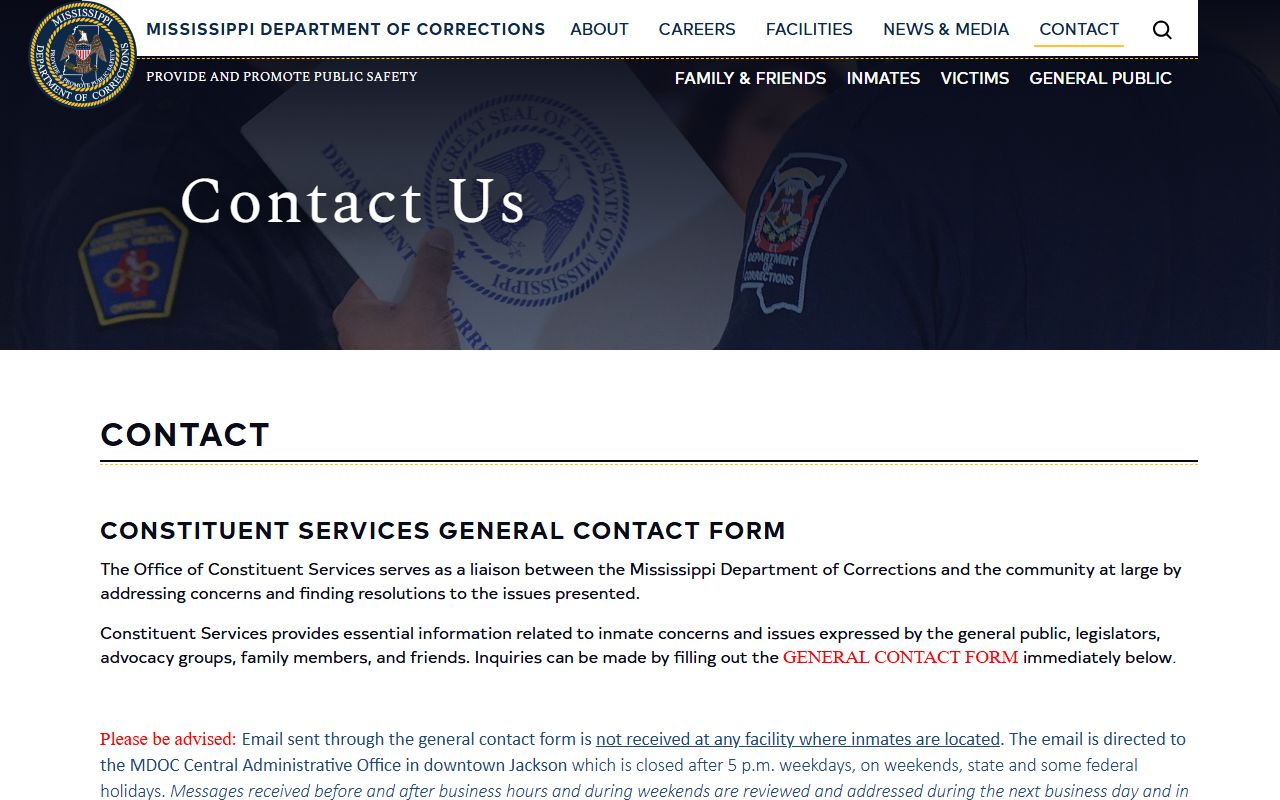
Its contact and records page lists the records department and is the route for confirming whether a conviction sent someone into state custody. MDOC also publishes its facility network, which is where a person moves once a county case ends in a prison sentence.
The MDOC facilities list shows where state inmates are held after sentencing.

A Madison County charge that ends in a felony conviction may show up in the MDOC inmate search rather than the county jail roster. Court charge records are also distinct from a state driver record, which the Mississippi Department of Public Safety keeps separately for traffic history.
Note: Mississippi's Public Records Act, Title 25, Chapter 61, keeps most charge records open to the public unless a specific exemption applies.
Federal Charges in Madison County
Some Madison County arrests lead to federal charges instead of state charges. Madison County sits in the U.S. District Court for the Southern District of Mississippi, in the Northern Division, with court offices in Jackson. A state arrest does not normally appear in federal court unless the U.S. Attorney files the charge.
Federal prosecutions for the district are handled by the U.S. Attorney's Office.
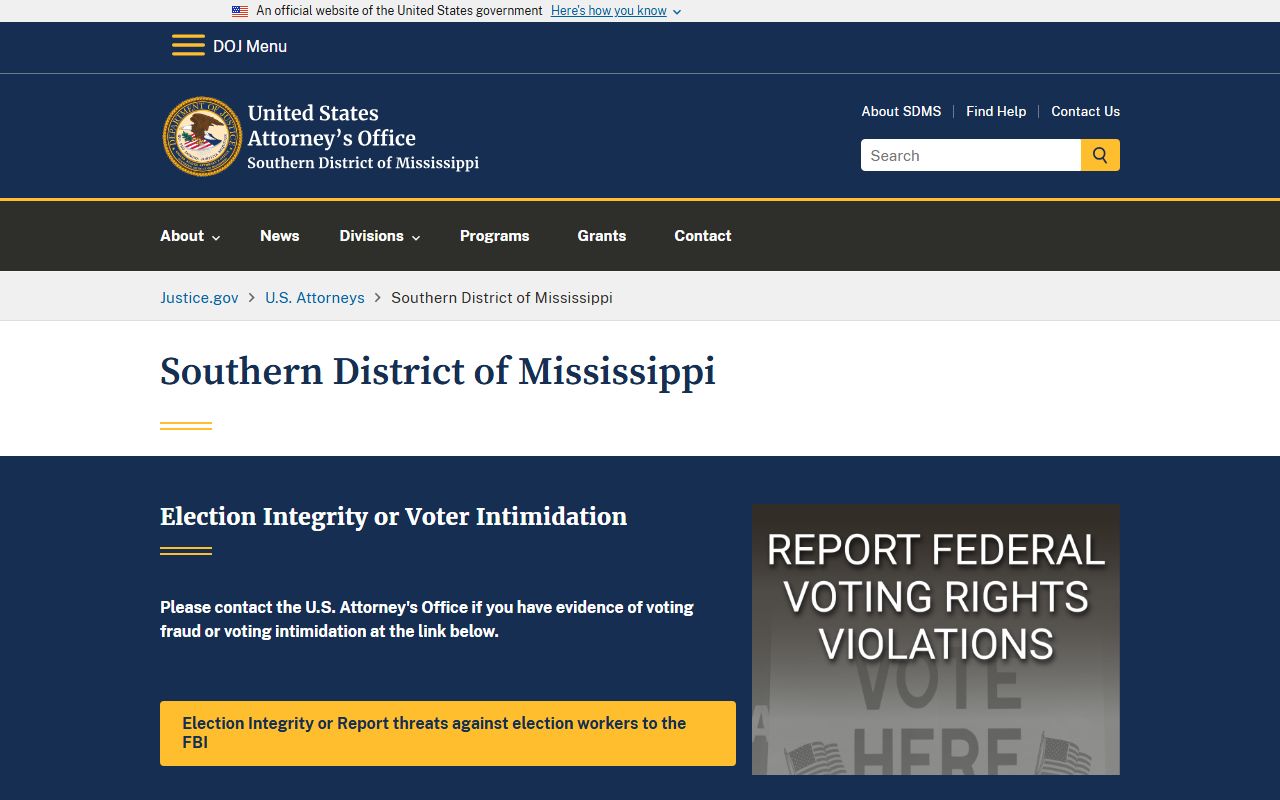
The U.S. Attorney's Office for the Southern District of Mississippi prosecutes federal crimes that may arise from a Madison County case. Federal charge records are searched through PACER for the Southern District, while the Bureau of Prisons inmate locator covers people in federal custody. These filings live entirely apart from the county clerk's index.
Background Checks and Charge Records
People search Madison County arrest records for many reasons, from personal due diligence to tenant or hiring decisions. The legal weight of a charge record depends on how it is used. A casual name lookup is not the same as a regulated background check.
Formal background checks for employment, housing, credit, or insurance fall under the federal Fair Credit Reporting Act and must run through a licensed consumer reporting agency. Records pulled directly from a court index or a jail roster are public information, but they are not an FCRA-compliant report.
Important: Arrest and charge records gathered here may not be used for employment, tenant, credit, or insurance decisions governed by the Fair Credit Reporting Act.
Restricted and Expunged Charge Records in Madison County
Not every charge stays publicly visible. Some Madison County charge records are confidential by law, and others can be cleared through expungement once a case ends. Knowing which category a record falls into explains why a charge may not appear in an ordinary search.
Youth Court charges involving juveniles are confidential under Mississippi youth-court law, and search warrants and active investigations are often withheld until they are executed or closed. Charges that are dismissed, nonadjudicated, or that end in a not-guilty result may be expunged so they no longer appear as ordinary public records. Convictions for certain sex offenses, by contrast, are published separately on a statewide registry the Sheriff's Department links.
The Mississippi sex offender registry is a public record that operates apart from the county charge index.
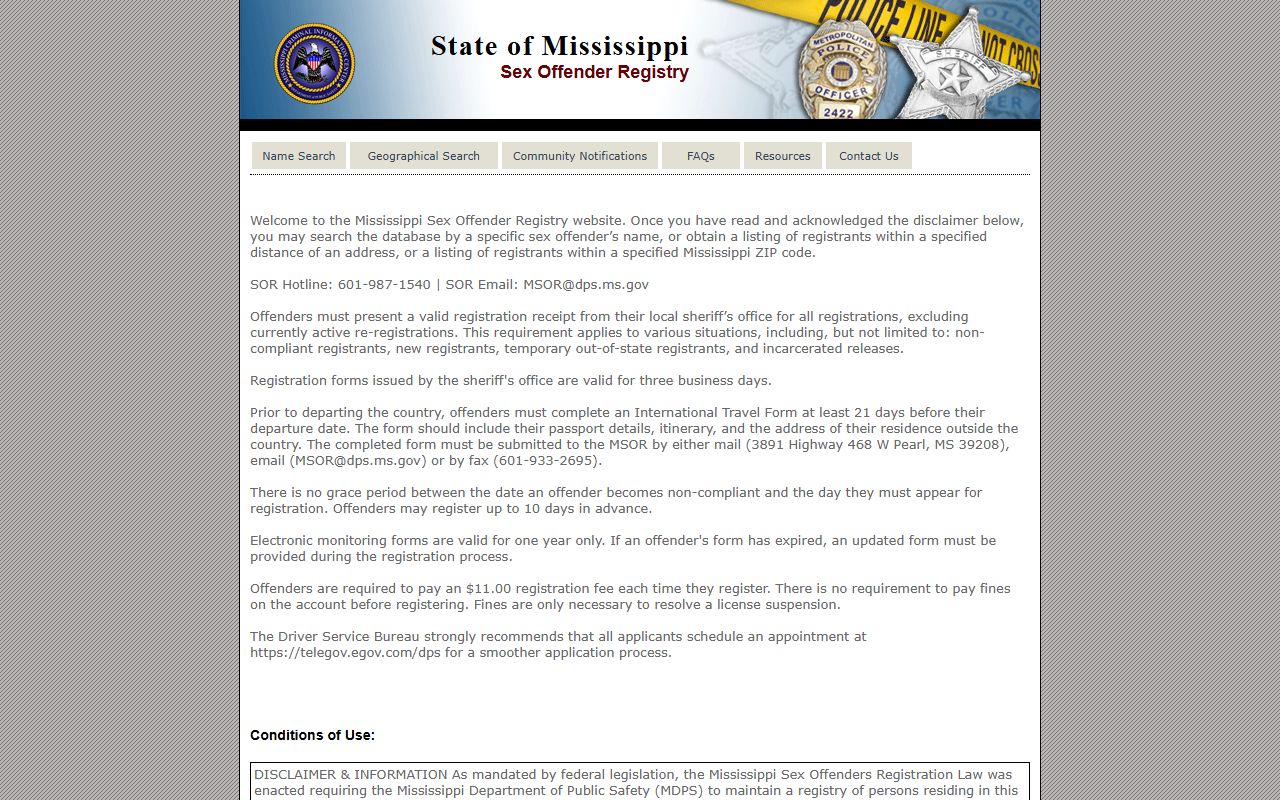
The registry covers offenders by conviction and is not a general charge search. Expungement, on the other hand, is filed in the court that handled the charge, and the Circuit Clerk's fee schedule sets the cost by category.
- Nonadjudication, dismissed, not-guilty, no-disposition, or pretrial-diversion cases under Section 99-15-26: $161.
- Drug-crime nonadjudication under Section 41-29-150: $161.
- Conviction expungement under Section 99-19-71: $311.
Conviction expungements face stricter limits than dismissed or nonadjudicated cases. Gather the case number, the charge, the disposition, and proof the sentence is complete before filing, then call the Circuit Clerk at 601-859-4365 for local filing steps.