
Criminal Court Records in Madison County
A criminal court record is the case file the clerk of court opens the moment the State of Mississippi files a charge against a person. It is not a single document. It is a running file that grows as the case moves, holding the charging paper, every motion and order, each hearing date, the plea, the verdict or guilty plea, and the final sentence. In Madison County, the Circuit Clerk maintains the criminal trial dockets and the full court records for Circuit Court and County Court, along with court costs, fines, and assessments tied to each case. The clerk is the official custodian, so the most complete and certified copy of any criminal case file comes from that office rather than from a casual online lookup.
Several courts produce criminal records in Madison County, and the level of the charge decides which one holds the file. Circuit Court is the felony trial court, where indictments, pleas, dispositions, sentencing, post-conviction filings, and appeals are recorded. County Court hears some criminal matters and can take non-capital felony cases transferred down from Circuit Court, which is why a felony file is not always in Circuit Court alone. Justice Court handles misdemeanor charges, preliminary felony proceedings, and county traffic citations. Municipal courts in cities such as Madison, Ridgeland, and Gluckstadt handle city misdemeanors and ordinance violations. Many charges first surface on the jail roster after an arrest, then mature into a full criminal case file once a court opens it.
That split matters for searching. A charge written by a city police officer usually stays at the municipal court, while a charge from the Sheriff's Department or the Highway Patrol often routes through Justice Court before any felony moves up. The detailed charges themselves are covered on the Madison County arrest records and court charges page, and the broader set of civil, family, and probate files sits with the county's general court records. The criminal case file is the record that ties an accusation to its outcome.
The County Prosecutor handles many of the charges heard in the lower courts, and the official county page describes that role in plain terms. The lead-in image below opens the Madison County County Prosecutor page, which explains how the office prosecutes Justice Court and County Court cases.
View the Madison County County Prosecutor page for the office that carries lower-court criminal matters.
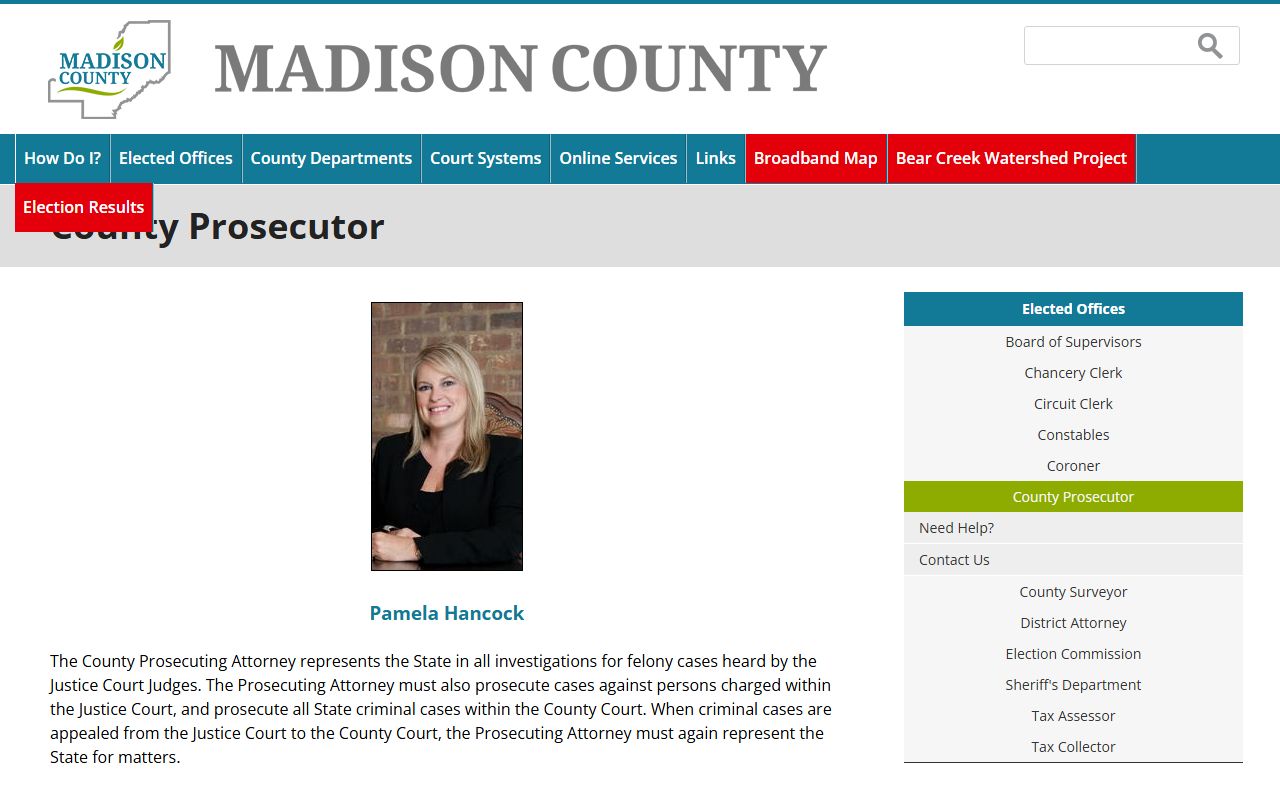
That page shows why not every Madison County criminal court record begins with the District Attorney; misdemeanor and preliminary matters often run through the County Prosecutor first.
How to Search Madison County Criminal Court Records
Modern criminal case files in Circuit Court and County Court are reached through Mississippi Electronic Courts, the statewide electronic filing and access system known as MEC. Mississippi completed electronic filing statewide in 2025, so recent criminal cases are filed and stored electronically even when access still requires registration, a login, or a visit to a public terminal. Remote public users register with MEC, attorneys register separately, and document viewing may carry a fee. For older files, certified copies, or anything not visible online, the Circuit Clerk counter is the reliable fallback.
- Open the Mississippi Electronic Courts portal and register for a public account, then select Madison County Circuit Court or County Court as the court.
- Search by the defendant name or, if you have it, the case number, which gives the cleanest single result.
- Narrow the search by court level, case type, and filing date to separate criminal matters from civil ones.
- Open the case to read the docket, the charges, and the disposition, then note any sealed or restricted entries.
- Request a certified copy from the Circuit Clerk if the file is needed for a legal proceeding, since uncertified screen copies are not official.
When a case is not online, the channel depends on the court. Call the Circuit Clerk at 601-859-4365 for Circuit and County Court files, or visit the counter at 146 West Center Street in Canton for Circuit criminal records. Justice Court and the municipal courts hold their own misdemeanor and traffic files, so a city ticket or a sheriff-issued citation is searched at that court rather than through the Circuit Clerk. There is no single statewide public criminal-history search for general use; sentenced state prisoners appear in the Mississippi Department of Corrections inmate search, which is separate from the county case file.
How a Criminal Case Moves Through the Court
A criminal case follows a set path, and each step leaves its own mark in the record. Reading a file is easier once you know which stage produced which entry. A docket that stops at arraignment describes a very different case than one that runs all the way to sentencing.
Case flow: Charges Filed › Arraignment › Pretrial / Motions › Plea or Trial › Disposition › Sentencing
| Stage | What Happens |
|---|---|
| Charges Filed | The State files a complaint, information, or grand jury indictment, and the clerk opens the case file under a case number. |
| Arraignment | The court reads the charges and the defendant enters a plea, such as guilty or not guilty. Bond conditions are often set or confirmed here. |
| Pretrial / Motions | Lawyers file written requests asking the judge to rule on evidence, discovery, or the charges. Continuances and hearing dates show up in this stretch. |
| Plea or Trial | Most cases end in a plea. Others go to trial, where a judge or jury decides guilt. A jury verdict is entered on the record either way. |
| Disposition | The final outcome of each charge is recorded, whether guilty, not guilty, dismissed, or nonadjudicated. |
| Sentencing | After a conviction or guilty plea, the judge imposes the sentence, which may include prison, probation, fines, or restitution. |
Felony cases that reach a jury are the most fully documented. One Madison County Circuit Court matter ran a two-day trial before a jury convicted a Fort Lauderdale man of eleven counts of auto burglary and one count of conspiracy, with the District Attorney noting he faced up to 82 years as a non-violent habitual offender. The lead-in link below opens the District Attorney announcement describing that conviction.
Read the District Attorney release on the auto-burglary conviction for a look at how a jury trial closes out in the record.
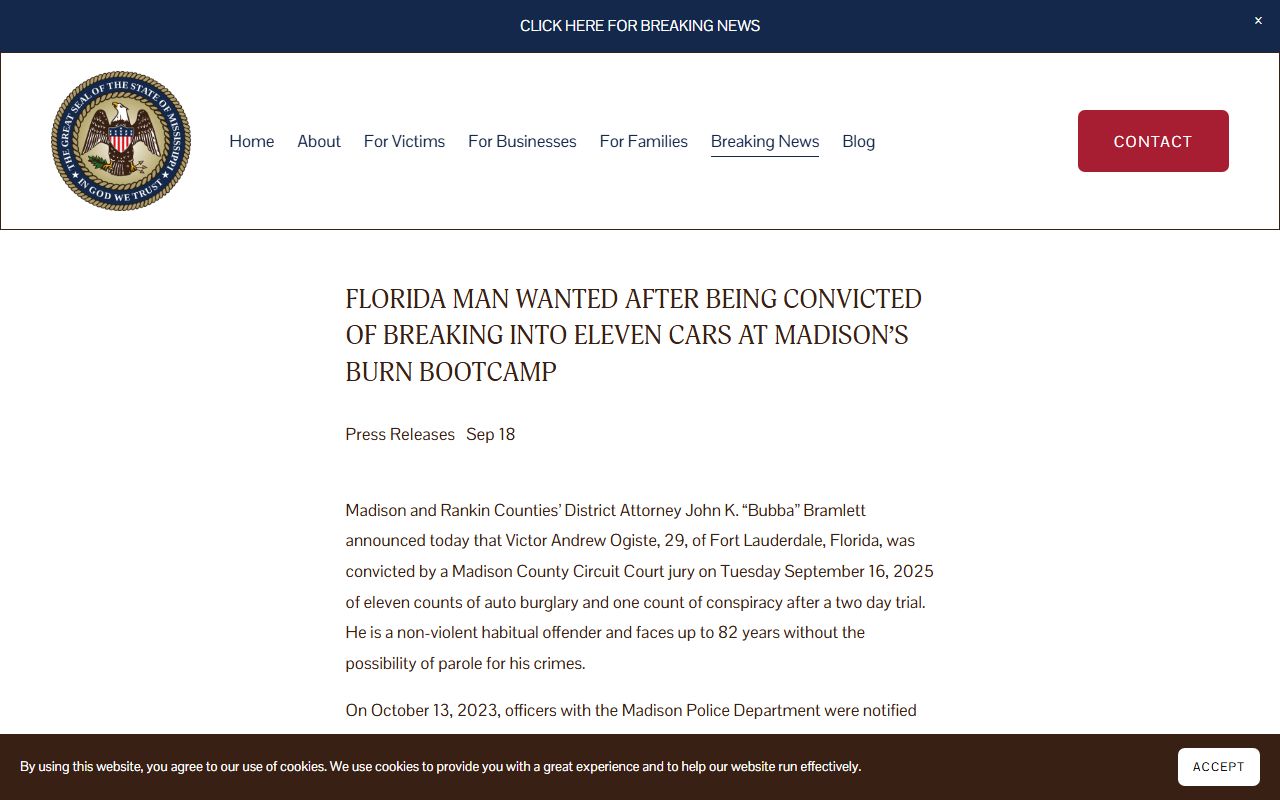
Each of those stages, from the indictment through the jury verdict, is a separate line in the criminal case file the clerk keeps.
What a Madison County Criminal Court Record Shows
A criminal case file is organized into fields, and most files share the same core set. The exact format depends on the court and the system, but a reader can expect each of the entries below. Knowing the fields helps you confirm you are looking at the right person and the right charge before drawing any conclusion.
| Field | What It Shows |
|---|---|
| Case Number | The unique number the clerk assigns when the file opens, used to pull every later document in the case. |
| Court / Venue | Which court holds the case: Circuit, County, Justice, or a named municipal court. |
| Parties | The State of Mississippi as the prosecuting party and the named defendant charged with the offense. |
| Filing Date | The date the charge was filed or the indictment returned, which starts the case timeline. |
| Charges | Each offense as charged, with its statute and severity level, plus any later amendment or reduction. |
| Plea | The defendant's answer to each charge, such as guilty, not guilty, or no contest. |
| Docket Entries | The running log of motions, orders, hearings, continuances, and warrants entered in the case. |
| Disposition | The final result of each charge, including conviction, acquittal, dismissal, or nonadjudication. |
| Sentence | The punishment imposed after a conviction, such as prison time, probation, fines, or restitution. |
| Financial | Court costs, fines, assessments, restitution, and bond amounts tied to the case. |
Some details are removed from public view. The county redacts personal identifiers such as Social Security numbers, dates of birth on some records, driver's license numbers, and financial account numbers. Jail records do show a date of birth and physical descriptors, but classification, medical, and security details are not public.
Charges Versus Convictions
Being charged is not the same as being convicted. A criminal court record can show charges that were later dropped, dismissed, or that ended in acquittal at trial. A charge is only an accusation that rests on probable cause. A conviction is a legal finding of guilt, reached either by a plea or by proof beyond a reasonable doubt. Reading a file without that distinction in mind is one of the most common mistakes people make.
| Charge | Conviction | |
|---|---|---|
| Stage | Accusation at filing | Verdict or plea |
| Burden of Proof | Probable cause | Beyond a reasonable doubt |
| Who Decides | Prosecutor and grand jury | Judge or jury |
| Public Record | Yes | Yes |
The record carries the full arc, and a conviction with a sentence is the clearest endpoint. In one Madison County Circuit Court case, a woman pled guilty to aggravated assault for setting her former boyfriend on fire and received a twenty-year sentence, the maximum allowed for that offense. The lead-in link below opens the District Attorney announcement of that plea and sentence.
See the District Attorney release on the aggravated-assault sentence for how a plea and its sentence read in the record.
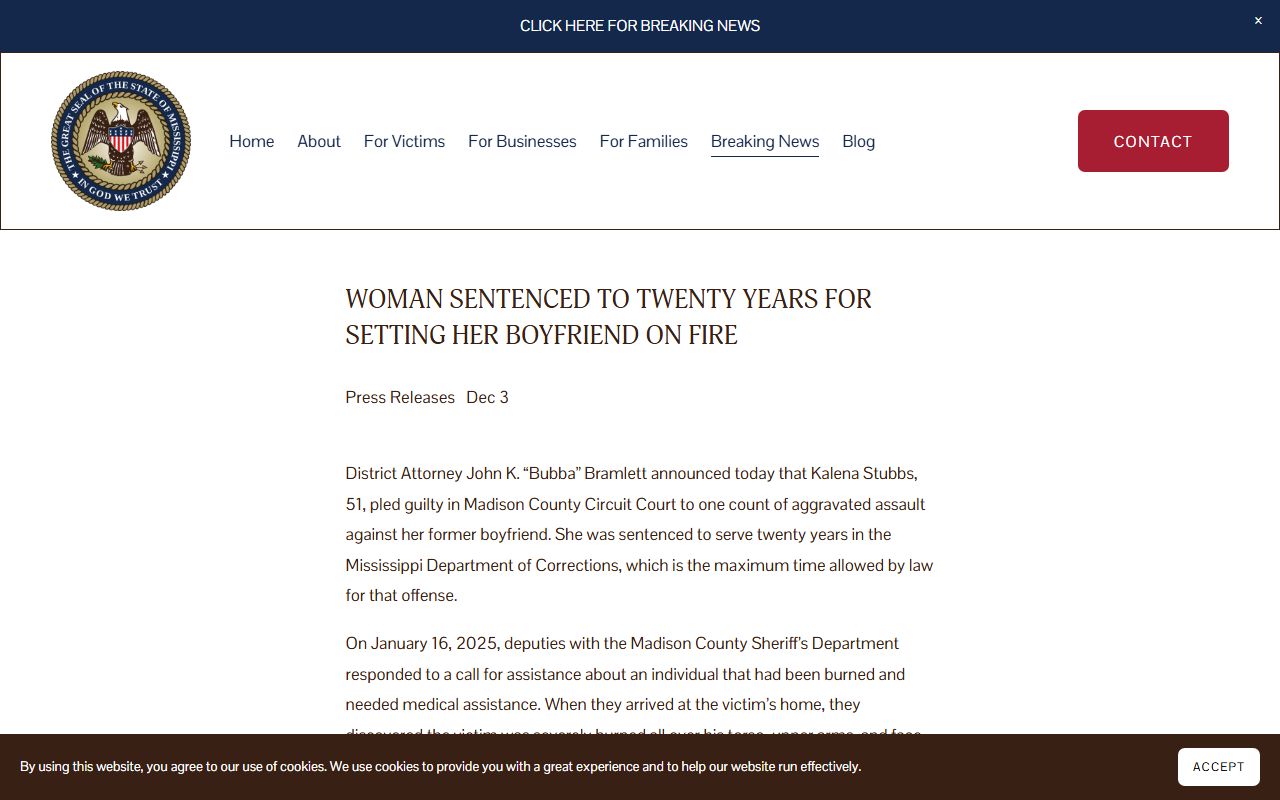
That outcome sits at the conviction end of the scale, while a dismissed charge in the same kind of file would carry no sentence at all.
Reading Dispositions and Sentences
The disposition is the final outcome of a charge, and the sentence is the punishment that follows a conviction. A single case can hold several charges, each with its own disposition, so one file may show a conviction on one count and a dismissal on another. The terms below appear often in Madison County criminal files and are worth knowing before reading a docket.
- Disposition
- The final result recorded for a charge, such as guilty, not guilty, or dismissed.
- Nonadjudication
- A path where the court withholds a formal guilt finding if the defendant meets set conditions.
- Dismissed with prejudice
- The charge is ended and cannot be refiled on the same claim.
- Dismissed without prejudice
- The charge is ended but may be refiled later if allowed.
- Sentence
- The punishment imposed after a conviction, including prison, probation, fines, or restitution.
- Probation
- Court supervision in the community in place of, or after, time in custody.
Sentences in serious felony cases can run without the chance of early release. In one Madison County Circuit Court matter, a Jackson man pled guilty to one count of sale and one count of trafficking of fentanyl and received ten years with no parole or early release. The lead-in link below opens the District Attorney announcement describing that plea and sentence.
Read the District Attorney release on the fentanyl plea for a clear example of how a sentence is stated.
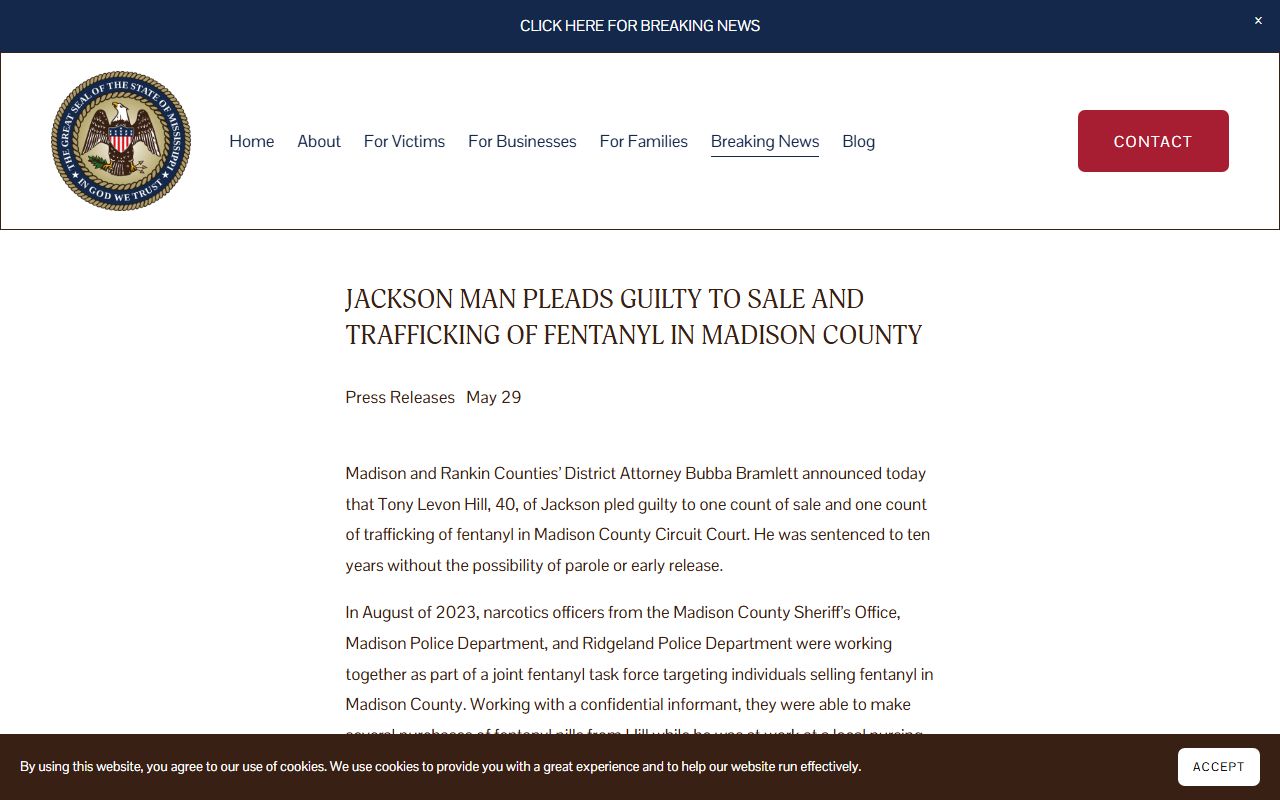
The sentence line in the file would carry that ten-year term and the no-early-release condition, which shapes how the record reads for years afterward.
Who Prosecutes Criminal Cases in Madison County
Two prosecuting offices drive criminal cases in the county, split by court level. The District Attorney handles felonies in Circuit Court, while the County Prosecutor carries matters in Justice Court and County Court. Knowing which office owns a case helps explain where its record lives and who announced the outcome.
The District Attorney is John K. Bramlett Jr., who serves the 20th Circuit Court District covering Madison and Rankin counties. His office prosecutes felony and other serious state criminal matters in Circuit Court, and it publishes guilty pleas, jury convictions, and sentencing announcements. The lead-in link below opens the official District Attorney site.
Visit the District Attorney site for the 20th Circuit Court District to see the office that prosecutes Madison County felonies.

That site is the public face of felony prosecution in Madison County and connects the criminal court record to the office that built the case.
The County Prosecutor, Pamela Hancock, represents the State in felony investigations heard by Justice Court judges, prosecutes charges within Justice Court, prosecutes state criminal cases in County Court, and represents the State again when cases are appealed from Justice Court to County Court. Because of that role, many misdemeanor and preliminary records are tied to the County Prosecutor rather than the District Attorney. The District Attorney also keeps a running index of recent prosecutions and public-safety announcements. The lead-in link below opens that press-release index.
Browse the District Attorney breaking-news index for recent Madison County prosecutions and outcomes.
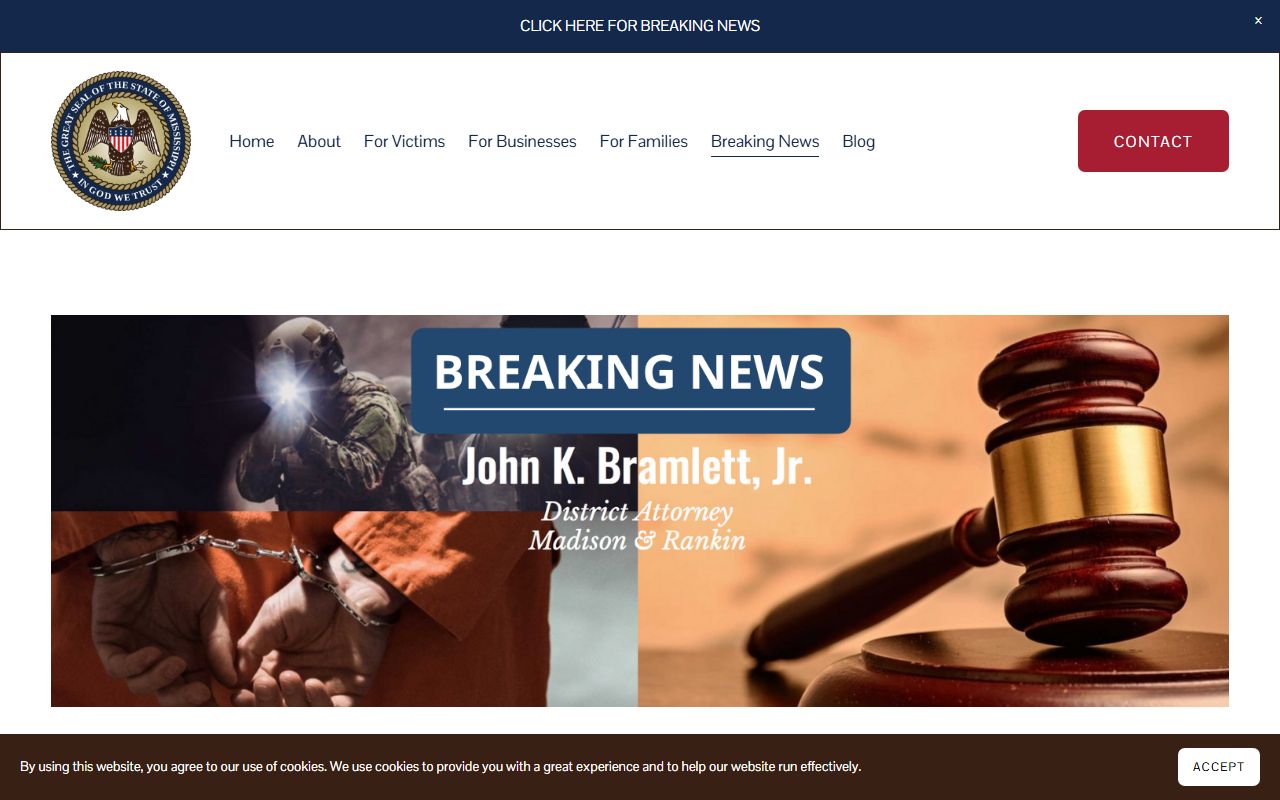
That index is a useful starting point for tracing a recent felony outcome back to its full case file in Circuit Court.
Sealed Versus Expunged Records
Not every criminal record stays open forever. Some are sealed, which hides them from general public view, and some are expunged, which removes them so they are treated as though the matter never happened. Mississippi sets different paths and fees for expungement depending on whether the case ended in a conviction, a nonadjudication, or a drug-related disposition.
| Sealed | Expunged | |
|---|---|---|
| Visibility | Hidden from public view | Removed and treated as never existing |
| Law Enforcement | Limited access remains | Very limited access |
| Eligibility | Set by statute or court order, often for sensitive or youth matters | Nonadjudication, dismissal, and certain convictions under state law |
| Madison County Fee | Varies by case type | $161 under Section 99-15-26 or 41-29-150; $311 for convictions under 99-19-71 |
An expungement in Madison County is filed in the court that handled the charge, not in a separate office. Nonadjudication, no-disposition, dismissed, not-guilty, and pretrial-diversion matters fall under Section 99-15-26 at a $161 fee. Drug nonadjudication matters fall under Section 41-29-150, also at $161. Eligible convictions are expunged under Section 99-19-71 at $311, and that conviction path carries stricter limits than the others. The petition goes to the Circuit Clerk for Circuit and County criminal matters, or to the Justice or municipal court for lower-court convictions and citations. Gathering the case number, charge, disposition, and proof that any sentence was completed first makes the filing smoother. For local filing steps, the Circuit Clerk office at 601-859-4365 is the place to ask.
Public Access to Criminal Court Records
Mississippi treats most court records as open. The state Public Records Act makes public records available for inspection unless another law provides an exemption, and it treats access as a duty of public bodies rather than a favor. For criminal court files, that means charges, dispositions, and sentences are generally open, while sealed cases, youth-court files, and expunged matters are not. The right place to start is the record custodian: the Circuit Clerk for Circuit and County Court files, and the relevant lower court for its own cases.
Key Statutes:
Mississippi Code § 25-61-1 - establishes the Public Records Act, making public records open for inspection unless an exemption applies.
Mississippi Code § 43-21-261 - keeps youth-court records confidential and limits who may see records involving children.
Online tools can be enough for an uncertified look, but they are not the official record. The county warns that the files held in the courthouse and clerk offices control over any online copy, and that certified records are needed for legal filings. For a complete older file, a certified copy, or a dispute about accuracy, the physical clerk office or an official public terminal is the dependable source.
Background Check Considerations
Looking up a single criminal case is not the same as running a background check. A formal background check used for hiring, housing, or credit must follow the federal Fair Credit Reporting Act, which sets accuracy and notice rules that a casual record search does not. A public criminal file can also be incomplete, out of date, or missing a later expungement, so it should be confirmed with the clerk before it is relied on for any decision.
Important: Criminal court records gathered here may not be used for employment, tenant, credit, or other screening governed by the Fair Credit Reporting Act.
Restricted Criminal Court Records in Madison County
Some criminal-related records are closed by law or by court order. Youth Court files are the clearest example, since records involving children are generally confidential and open only to authorized staff, the parties, counsel, and people allowed by youth-court law or a judge. Mississippi sets the outer age for youth-court jurisdiction at eighteen at the time of the offense, and those files are not ordinary public records.
Other restricted categories include sealed cases, expunged matters, and records with redacted personal identifiers. Search warrants are often sealed before they are carried out, so they do not appear as public lookup items. Active investigations may also be withheld even when a later case file becomes public. A reader who cannot find a case online should not assume it does not exist; it may be restricted, may sit in a different court, or may simply predate electronic filing. Calling the custodian clerk is the surest way to learn which of those applies.
Note: A case missing from an online search may be sealed, restricted, held in a lower court, or older than electronic filing, so confirm its status with the custodian clerk.