
Probate Falls Under Chancery Court in Madison County
Mississippi does not have a separate probate court. In Madison County, probate is handled in Chancery Court, the equity court that also hears divorce, custody, support, and land disputes. The Chancery Court page confirms that the chancellors hear wills and estates, and the bench is part of the Eleventh Chancery Court District. Three judges serve the district by sub-district: Robert G. Clark III for Sub District One, Cynthia Brewer for Sub District Two, and James C. Walker for Sub District Three. Chancery Clerk Ronny Lott is clerk to the court, receives and assigns cases to one of the three judges, maintains the docket, keeps the minute books, and accounts for filing fees.
Probate in Madison County covers far more than a last will and testament. Chancery Court handles wills and estates, guardianships, conservatorships, minor settlements, ward settlements, letters of conservatorship and guardianship, fiduciary certificates, and the court minutes and orders generated along the way. The same court processes civil commitments for mental health and drug or alcohol matters. Because divorce and probate share the Chancery docket, families dealing with an estate sometimes have related divorce and family records in the same court. The Chancery Clerk may also be called on to serve as a court-appointed guardian, administrator, executor, conservator, or commissioner.
The Chancery Clerk publishes a duties of the clerk page that spells out the office's role in keeping the Chancery Court docket, filing every record of the court, issuing process, and processing appeals to the Mississippi appellate courts.
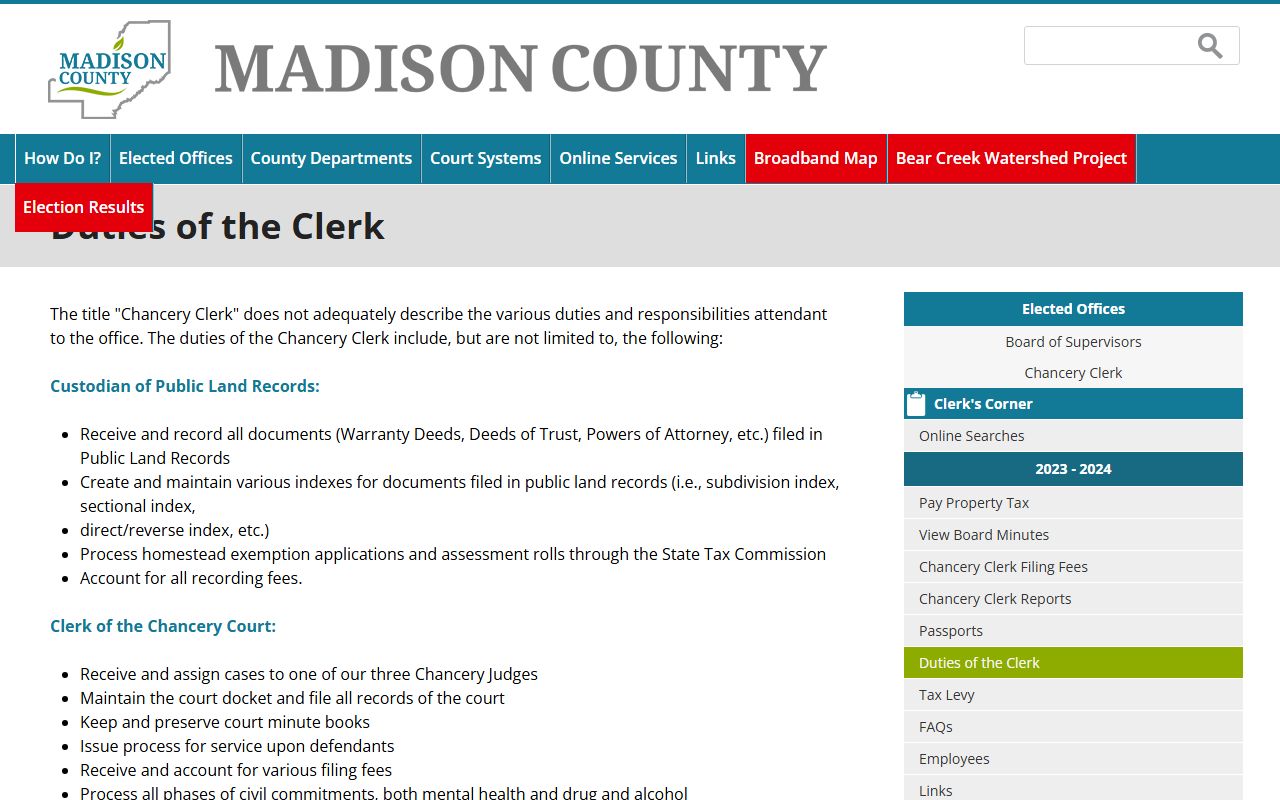
Those listed duties make the Chancery Clerk the first stop for anyone pulling a Madison County probate file, whether the matter is a small guardianship or a contested estate.
Probate Terms Defined
Probate filings use a vocabulary that can be confusing to families handling an estate for the first time. The terms below appear across Madison County wills, estate petitions, and guardianship paperwork, and knowing them helps when reading a docket entry or a set of letters issued by the clerk.
- Testator
- The person who made the will. When that person dies, the will is offered for probate in Chancery Court so the estate can be settled according to its terms.
- Executor
- The person named in the will to carry out its instructions, gather assets, pay debts, and distribute property. The court issues letters testamentary confirming that authority.
- Intestate
- Dying without a valid will. An intestate estate is distributed under Mississippi descent and distribution law, and the court appoints an administrator rather than recognizing a named executor.
- Guardianship
- A court arrangement giving one person legal authority over a minor or over the person of an incapacitated adult. In Madison County a guardianship is opened and supervised through Chancery Court.
- Conservatorship
- A court arrangement placing an adult's financial or personal affairs under a conservator when the adult cannot manage them. The court issues letters of conservatorship defining the conservator's powers.
How to Search Madison County Chancery Court Records
There is no single button that returns every probate record in the county, because the files are split by date and by type. Modern case files live in the statewide electronic system, older wills sit in historical books at the courthouse, and estate-related property records are searched through a separate land portal. The path depends on whether the matter is recent, decades old, or tied to real estate.
- For Chancery Court cases filed from January 2010 forward, use Mississippi Electronic Courts. Madison County moved its Chancery filings into MEC in January 2010, and cases from that date are available only through MEC or the public terminals in the clerk's office, not the old county website. Members of the public register for MEC access separately from attorneys.
- For wills before 2010, search the historical will books. The Chancery Clerk's office maintains will books running from 1828 through December 31, 2009, one of the deepest record sets in the county and a major resource for genealogy and estate research.
- For deeds, liens, and other property tied to an estate, use the DuProcess Official Records Inquiry land-record portal described below.
- To review official, certified, or older hard-copy material, visit the Chancery Clerk at 146 W. Center Street in Canton, where public terminals and staff can locate files that are not online.
- For certified copies or instructions on older files, contact the Chancery Clerk by phone or mail before traveling, since some pre-digital records exist only in physical form in Canton.
Note: Online copies are convenience copies; the county warns that the official records kept in the clerk's office control when there is any difference.
How Probate Works in Madison County
A Madison County probate or guardianship matter moves through Chancery Court in a predictable order, from the first petition to the documents the clerk preserves at the end. The steps below follow the local process and the procedures set by the Eleventh Chancery Court District local rules.
- File the probate, estate, guardianship, conservatorship, or related petition in Chancery Court through the Chancery Clerk.
- The clerk receives the filing and assigns the case to one of the three Chancery Judges.
- The clerk issues process so that interested parties and respondents can be served when service is required.
- The case proceeds under Mississippi chancery practice and the Eleventh Chancery Court District local rules.
- Orders, minute entries, letters, inventories, accountings, and related documents are filed and preserved by the Chancery Clerk.
- For minor or ward settlements over $10,000 gross, the local rules require a guardianship to be established.
- Records from 2010 forward are available through MEC and the public terminals, while older wills follow the separate historical search paths.
Madison County Chancery Court and Clerk Contact
Probate filings, certified copies, and public-terminal access all center on the Chancery building in downtown Canton. The Chancery Court and the Chancery Clerk share the address below, which is also the Chancery side of the county's split court geography. Callers should confirm hours and counter before visiting, since not every county record function sits in this one building.
Madison County Chancery Court and Chancery Clerk
Chancery Clerk Ronny Lott
146 W. Center Street
Canton, MS 39046
Chancery Court 601-859-1177
Public terminals available in the office
Probate Fees and Where to Find Them
Probate filing costs in Madison County are set and collected by the Chancery Clerk, who accounts for all filing fees as clerk of the court. Exact dollar amounts for opening an estate, issuing letters, or filing a guardianship were not published in plain text on the official county pages reviewed, so the safest course is to confirm the current charge directly with the clerk or on the official fee page. The categories below show what to ask about; the one firm, locally published rule is the threshold for ward settlements.
| Fee Category | Where to Confirm |
|---|---|
| Opening an estate or admitting a will to probate | Confirm with Chancery Clerk |
| Letters testamentary or letters of administration | Confirm with Chancery Clerk |
| Guardianship or conservatorship petition | Confirm with Chancery Clerk |
| Certified copies of probate documents | Confirm with Chancery Clerk |
| Recording estate-related land instruments | Confirm with Chancery Clerk |
The Chancery Clerk maintains an official filing fees page that links the court and land-record fee schedules. Use it, or call the office, before sending payment so the amount matches the current schedule.
Ward settlements over $10,000. Under the Eleventh Chancery Court District local rules, a settlement of a claim on a ward's behalf requires establishing a guardianship when the settlement consists of money or property valued at more than $10,000 gross, measured before legal fees and expenses rather than the net amount.
Probate Forms and Letters
Several probate and fiduciary documents are referenced through the county's official pages, which is useful for executors, guardians, and conservators preparing a filing. These forms support the letters and certificates the court relies on to confirm a fiduciary's authority.
- Certificate of Attorney.
- Certificate of Fiduciary Conservator.
- Certificate of Fiduciary Guardian.
- Sample Letters of Conservatorship.
- Sample Letters of Guardianship.
- Local Rules for the Eleventh Chancery Court District.
The local rules also coordinate related matters: related guardianships and minor settlements for siblings, step-siblings, half-siblings, or matters arising from the same cause are assigned to the chancellor who took the first case, and a minor settlement that arises out of an estate goes to the chancellor already handling that estate.
Land Records Connected to Estates
Estates frequently involve real property, so a complete probate search often crosses into the Chancery Clerk's land records. The Chancery Clerk is custodian of all land records and records warranty deeds, deeds of trust, powers of attorney, liens, and plats. The DuProcess Official Records Inquiry portal lets users search those instruments by grantor or grantee name, date range, instrument type, book and page, legal description, or parcel identifier, which helps confirm how property passed through or out of an estate.
DuProcess is a land-record search, not a court case search, so it does not return the probate case file itself. Its disclaimer notes that online data is informational, may be updated daily except on weekends and holidays, is not certified, and that the official records in the clerk's office control. For estate research, pair a DuProcess property search with the MEC case file or the historical will books to see both the court proceeding and the property record. The Chancery Clerk role is also described on the county's clerk of court overview.
Representation in Conservatorship and Commitment Matters
Some Chancery matters touch a person's liberty or capacity, not just their property. Civil commitments for mental health or substance use, and conservatorships over an adult who cannot manage personal affairs, can require legal representation for the person at the center of the case. The Eleventh Chancery Court District local rules treat commitments as urgent matters assigned to the most readily available chancellor.
The Mississippi Office of State Public Defender provides context for how appointed counsel is organized statewide, with divisions covering appeals, capital defense, family defense, training, and youth defense.

For a specific conservatorship or commitment in Madison County, the appointment of counsel is handled by the court, so families should ask the Chancery Clerk or the assigned chancellor how representation is arranged rather than assuming a particular attorney is involved.
What Madison County Probate Records Show
A Madison County probate file builds a paper trail of how an estate or a protected person's affairs were managed. Depending on the type of matter, the record may contain the will itself, the petition that opened the case, and the letters the court issued to confirm a fiduciary's authority. Estate files typically include inventories of assets, accountings of money received and paid out, and orders directing how property is distributed.
Guardianship and conservatorship files show the appointment of the guardian or conservator, the scope of authority granted, and the ongoing reports the fiduciary must file. Across these matters the parties are labeled as petitioner and respondent rather than plaintiff and defendant. The historical will books, running from 1828 through the end of 2009, preserve the wills and probate entries of earlier generations and remain a primary source for both legal heirs and family historians researching Madison County ancestors.
Restricted Probate Records
Not every part of a probate or related Chancery file is open to the public. Guardianship and conservatorship records can carry medical and capacity details that are sensitive, and minor settlements involve children whose information is protected. Civil commitments for mental health or drug and alcohol matters involve medical and liberty interests and are not treated as ordinary searchable civil records. Contested estate disputes may also be sealed in part by court order.
Adoption proceedings, which are also Chancery Court matters in Mississippi, are confidential and not public records except by court order. The land-record privacy rules identify Social Security numbers, dates of birth, driver's license numbers, and bank and card account numbers as categories that are redacted from public images. Anyone seeking a restricted or partially sealed probate record should expect to show standing or obtain a court order, and the Chancery Clerk applies the Mississippi Public Records Act exclusions when responding to a request.